Have a question? Call us Now
+91 9825072799
Choosing the right deep fryer machine is an important decision for any commercial kitchen. Whether you’re opening a new restaurant, café, cloud kitchen, or upgrading your existing setup, the right commercial deep fryer can improve cooking speed, food consistency, and overall kitchen efficiency while helping manage operating costs.
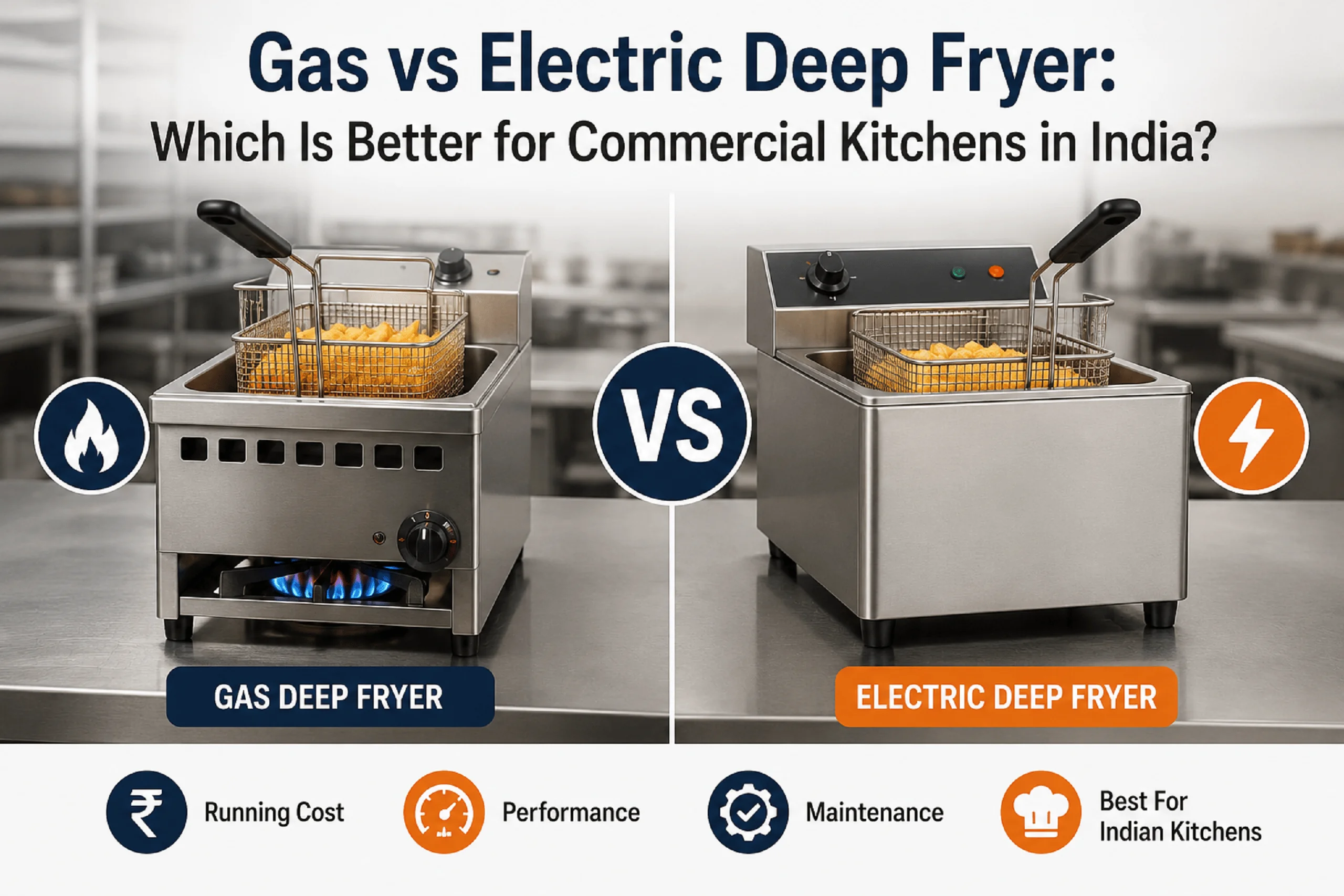
One of the most common questions restaurant owners ask is: Should you choose a gas or electric deep fryer? The answer depends on your kitchen layout, menu, available utilities, and daily frying volume. In this guide, we’ll compare gas and electric commercial deep fryer models based on performance, installation, maintenance, and running costs. We’ll also explain why a twin deep fryer is a practical solution for businesses that need to keep vegetarian and non-vegetarian frying completely separate.
A gas fryer heats oil through a burner positioned below or beside the fry pot, much like a cooking range. An electric unit works differently, its heating elements sit immersed directly in the oil, letting it heat evenly from within. That design difference explains most of the pros and cons of each type.
| Factor | Gas Deep Fryer | Electric Deep Fryer |
|---|---|---|
| Heat-up Speed | Faster, high BTU output | Slightly slower but consistent |
| Running Cost | Depends on LPG/PNG rates | Depends on electricity tariff |
| Installation | Requires gas connection and ventilation | Needs a stable electrical supply |
| Temperature Control | Manual, less precise | Digital, more accurate |
| Best For | High-volume restaurants, street-food outlets | Cafes, cloud kitchens, QSRs |
| Maintenance | Burner requires periodic servicing | Fewer moving parts, easier upkeep |
If you walk into any busy Dhaba or a kitchen which sells food from a busy street, you will definitely see a gas fryer. It heats up oil rapidly after each load which is very beneficial for continuous frying during peak hours and it maintains its oil temperature during a power cut, another great advantage in many parts of India.
The price to pay is the installation. Proper gas line, ventilation, and the proper safety fittings are required. The setup costs are slightly higher, but with many high-volume kitchens, the shortened recovery is worth it.
The most convenient electric deep fryer models are being favored by a number of cafes, bakeries, QSRs and cloud kitchens. Electric deep fryer models are becoming more popular and it is not hard to see why they are being selected by a wide number of cafes, bakeries, QSRs and cloud kitchens. They provide better temperature control and reduce burnt batches and oil downtime. Because there is no gas line, the installation is typically easier, and an excellent choice for smaller kitchens.
Be sure to check electrical capacity before purchase. High-power restaurants require reliable power service in order to operate properly.
Here’s something most comparison articles overlook: Indian customers, and FSSAI food safety guidelines, expect vegetarian and non-vegetarian food to be prepared separately wherever possible. Sharing one fryer for both isn’t just a hygiene concern, it affects customer trust and menu credibility too.
This is where a twin deep fryer becomes worth the investment. With two independent oil tanks and separate heating zones in one unit, you can fry veg and non-veg items independently, without buying two machines or giving up counter space. For restaurants, cafes, sweet shops, and caterers running mixed menus, this often matters more than the gas-versus-electric decision itself.
Many suppliers simply sell a fryer and move on. At Riddhi Display, we first understand your kitchen layout, menu mix, and utilities before recommending the right equipment, whether that’s gas, electric, or a twin deep fryer. Built from stainless steel and backed by dependable after-sales support, our fryers are designed for consistent results and everyday reliability.
Choosing between a gas fryer and electric fryer, you should consider your kitchen environment, menu and frequency of frying. For high volume restaurants, gas fryers are a good option, and for cafés and cloud kitchens, that require exact temperature control, electric fryers are recommended. A twin deep fryer may be helpful, especially when preparing meals that contain both meat and vegetables so that oil doesn’t get mixed in with the veg food and is kept separate and helps save space in the kitchen.
The right deep fryer machine can make a kitchen more efficient, the quality of the food, and daily operations better. Choose the best deep fryer solutions from Riddhi Display to power your Indian kitchen with reliable equipment for your business.
1. Which is cheaper to run, a gas or electric deep fryer?
Depends on where you’re based. Gas tends to be cheaper where LPG or PNG rates are subsidised, while electric can work out lighter where tariffs are low and usage stays moderate.
2. Is a twin deep fryer worth it for a small restaurant?
Yes, especially if you fry both veg and non-veg items. It takes less space than two separate fryers while keeping the oils fully separate.
3. Do electric deep fryers need special wiring?
Heavy-duty models usually need a dedicated power point, so check your electrical load before installation day.
4. Which fryer heats up faster, gas or electric?
Gas fryers generally heat up and recover temperature quicker, which helps during high-volume service.
5. How often should a commercial deep fryer be serviced?
Filter the oil daily, and schedule a maintenance check every one to three months depending on usage.
Copyright by Riddhi Display. All rights reserved.
Powered by: Icecube Digital