
Have a question? Call us Now
+91 9825072799
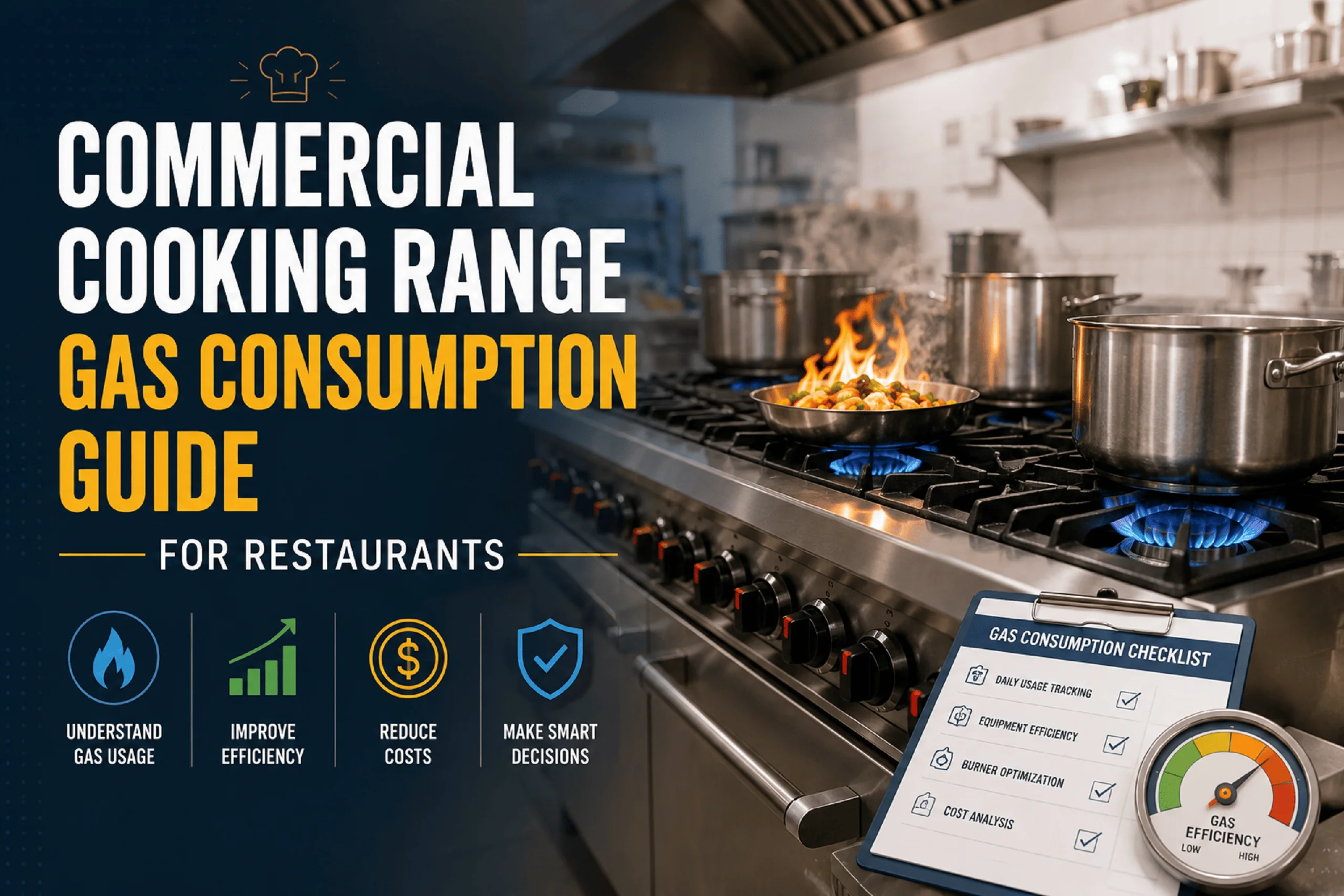
While every restaurant owner pays attention to food cost and rent, nothing happens until they get the gas bill and they realize it is cutting into their margins this way. Typically, the largest use of LPG in the kitchen is your commercial cooking range, which is on for 10-14 hours a day during service. The approximate amount of the gas that is consumed will not only help you to prepare a budget, but will also indicate whether your equipment is operating efficiently or whether it is wasting gas on each dish.
It simplifies the process of understanding how gas is used with commercial cooking equipment, what factors affect it, and how to calculate kitchen gas use without relying on educated guesswork.
The usage of gas is determined by the gas BTU output per hour for burner output and by the LPG draw in kg per hour. A standard commercial cooking burner for everyday use is typically 20,000-30,000 BTU/hr, and a high output burner, used for searing, wok cooking or bulk boiling, is much more. This is approximately 0.4-0.6 kg of LPG per burner per hour when the burners are fed with fuel, at a constant medium-high flame, though this can vary according to the design of the burner, how the burner is set and the serviceability of the range.
Most commercial kitchens in India use 19 kg commercial LPG cylinder which costs approximately ₹2,900 in most metros in India during mid-2026. Kitchens usually connect 2 or more cylinders in a manifold, or they switch to 47.5 kg cylinders that can provide a much higher flow rate, or they install just one 19 kg cylinder, since the flow rate is 0.5-0.6 kg/hr, sufficient for 1 or 2 burners operating continuously throughout service hours.
Two ranges with identical BTU ratings can still consume very different amounts of gas in daily use, and the difference almost always comes down to build quality and maintenance.
This is exactly why two restaurants with the same menu and same burner count can see very different monthly gas bills.
Because of the different loads a catering burner operates on compared to a regular kitchen range, its operation is quite different. A typical catering burner consumes about 0.8-1kg of LPG an hour and during the busy cooking periods, large events may have six to ten burners operating simultaneously. That can easily equate to 30-40 kg of LPG in a single cooking window at a 500 guest event or caterer would plan fuel by cooking window, not over the course of the entire event.
If you have a catering business with your restaurant, it is important to keep a separate record of gas usage for the bulk cooking equipment as the pattern of use and the amount of gas required is significantly different from the usual kitchen line.
You don’t need complicated formulas to get a working estimate. Here’s a simple way to calculate it:
Daily usage = (Number of active burners) × (Average kg/hr per burner) × (Active cooking hours)
For example,, if a medium-sized restaurant operates four burners, each using at an average 0.5 kg/hr, for a total of 8 hours per day, the daily consumption would be approximately 16 kg of LPG, equivalent to almost 480 kg per month. That converts to fuel cost ranging from ₹70,000/- to ₹75,000/- per month at present commercial LPG prices, apart from the ovens/tandoor/fuel fired commercial cooking equipment which are in addition to the range.
Do this calculation with your own kitchen with your actual number of burners and typical cooking times and compare with your actual cylinder use. There is a good chance that you are having trouble with your equipment if the estimated difference and the actual bills is a great distance.
Practical Ways to Reduce Gas Consumption
This is where equipment choice matters more than most owners expect. A well-fabricated commercial cooking range with precisely machined burners, correct jet sizing, and solid SS304 construction burns gas more evenly and holds its efficiency for years, while a poorly built one starts wasting fuel within months as joints wear and burners warp under constant heat.
At Riddhi Display, our cooking range and commercial cooking range lineup is built with this in mind from Indian burner ranges to high-output Chinese burner ranges and bulk cooking ranges for catering-scale kitchens. Every unit uses correctly sized burners and durable stainless steel construction, so the flame stays consistent and gas isn’t wasted heating the air around your cookware.
Energy-efficient commercial kitchen equipment is a simple way of cutting down on gas usage and gas operating expenses. An appropriate choice of cooking range, monitoring LPG consumption and regular maintenance of equipment will optimize cooking efficiency but without sacrificing cooking performance.
Riddhi Display is a leading commercial kitchen equipment distributor, producing high quality and energy efficient products, that serve the needs of restaurants, hotels and cloud kitchens with reliable performance, reduced fuel usage and long term cost savings.
1. How much LPG does a commercial cooking range use per day?
It depends on burner count and cooking hours, but a typical four-burner restaurant range running 8 hours a day uses roughly 15-16 kg of LPG, or close to one 19 kg cylinder daily.
2. What is the average BTU rating of a commercial cooking range burner?
Most standard burners run between 20,000-30,000 BTU/hr, while high-output burners for searing or wok cooking can exceed 40,000-90,000 BTU/hr.
3. How much gas does a catering burner consume per hour?
A catering burner typically draws 0.8-1 kg of LPG per hour at high flame, which is why large events plan fuel around peak-hour burner count rather than total event time.
4. Does the quality of commercial cooking equipment affect gas consumption?
Yes. Well-machined burners and solid construction burn more evenly and stay efficient for years, while cheaper equipment wastes gas as joints and burners wear out.
5. What’s the easiest way to reduce gas consumption in a restaurant kitchen?
Match cookware size to the burner, keep lids on while cooking, service burners regularly, and fix leaking regulators or hoses small habits that add up to real monthly savings.
Copyright by Riddhi Display. All rights reserved.
Powered by: Icecube Digital