Have a question? Call us Now
+91 9825072799
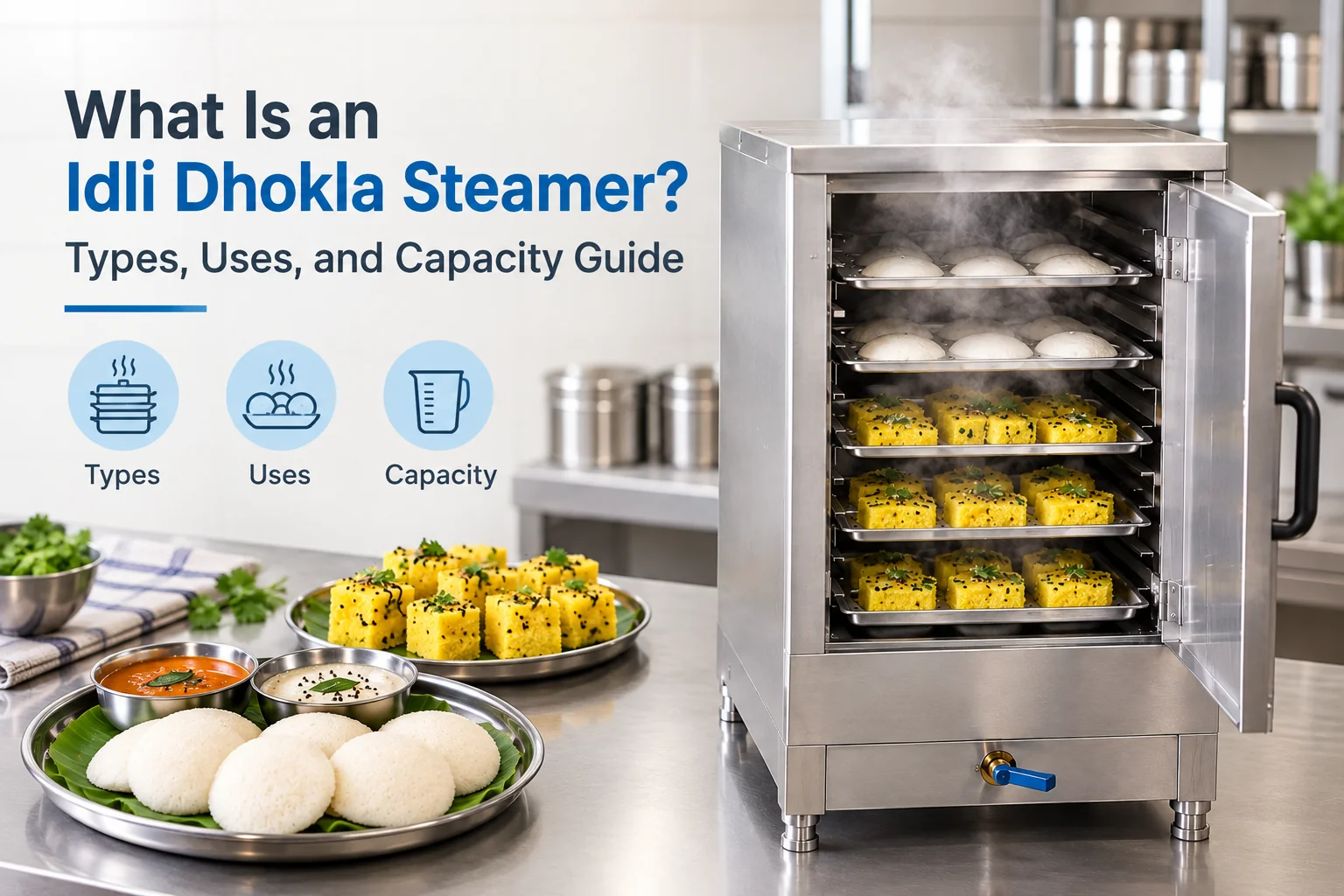
Idli and dhokla find their place on the menu of hotels, canteens, catering services, commercial food outlets, etc. These foods, when to be cooked in bulk, using a household steamer can be very time-consuming and tedious. Commercial idli dhokla steamer is meant to make bulk cooking of these foods more comfortable and efficient.
Designed to withstand multiple cycles of cooking, these steamers offer capacity for more than one tray at a time. They can be used, in the case of certain models, for steaming idli, dhokla, khaman, momos and many other types of food.
The selection of the suitable steamer depends on other aspects apart from the number of trays. Capacity, kitchen space, fuel type, construction, cleaning, and production that you need to work on a daily. This article let’s know what an idli dhokla steamer is and how it works, various types and what you need to consider to select the right capacity for a commercial kitchen.
Commercial idli dhokla steamer is used to make idli, dhokla and khaman in many trays. Conventional idli cooking method is to cook only a small portion of idli at one go but in a commercial idli cooker, many trays can be stacked on each other or inserted into the cooking chamber.
The interior produces steam that gently heats the food and cooks it without any direct exposure to a flame. As a result, food that needs to be cooked slowly and evenly can be steamed.
Commercial steamers are typically built strong and are suitable for everyday use. They come in various sizes and capacities, so a business can select a model that meets its daily production requirements.
The working principle is very simple. The water is heated and the steam is generated inside the steamer. The steam flows through the trays filled with the batter to cook the food.
Idli – Batter is poured into greased idli moulds before keeping the idli trays inside the steamer Dhokla/ Khaman – Batter is prepared in appropriate khaman or dhokla trays and then steamed till it is cooked to the right consistency.
The trays can then be taken out and the food let to cool for a few minutes once the cycle has been completed before you serve or prepare the food for serving. Cooking time depends on the recipe, amount of batter, tray configuration, cavity shape and operating conditions.
Commercial kitchens may select the size and configuration of the steamer depending on the production they require.
| Type of Idli Dhokla Steamer | Suitable For | Main Benefit | Space Requirement |
|---|---|---|---|
| Single-Tier Steamer | Small restaurants, cafés, food outlets | Suitable for smaller production needs | Low |
| Multi-Tier Steamer | Restaurants, canteens, food counters | Allows multiple trays to be cooked in one cycle | Moderate |
| Large-Capacity Steamer | Hotels, caterers, commercial kitchens | Suitable for high-volume bulk cooking | Higher |
| Gas Steamer | Commercial kitchens with gas supply | Uses gas for heating and steam generation | Depends on model |
| Electric Steamer | Kitchens with suitable electrical supply | Provides electric-based heating | Depends on model |
Single tier or a smaller steamer suit you where your production capacity is on the smaller side. It is ideal for small restaurants, cafes, eateries and outlets where the idli/dhokla is made in small quantities.
It is also advantageous due to its compact size that allows for easier installation in kitchens with limited space.
Multi-tier steamer – Which you’ve used before, a multi-tier steamer contains several tiers for steaming trays. This can be used to cook multiple batches in one cycle.
It may help to serve the purpose to restaurants, canteens, food counters, etc. that regularly serve foods like idli, dhokla or the like in one or more parts of the day.
When searching for a steamer that offers a large capacity, you are likely a kitchen that prepares a significant amount of food. Large-capacity steamers are often chosen by hotels, caterers, institutional kitchens and other high-volume food businesses.
More trays at one time in the bigger oven chamber, without the need for many small batches.
Idli dhokla steamers also can be categorized based on how they heat the water content. Those which work using gas use a gas burner and those which use electricity have an electric heating device.
Which option is best will rely on the available infrastructure in the kitchen, operating habits, the need to take into account alternative energy sources, and required installation.
These steamers may be known by the names of two great foods but they are not limited for idli and dhokla.
Depending on the tray setup and design, the commercial steamer could be used for:
Other foods suitable for steam cooking
The specific uses will vary based on how the steamer is designed and the types of trays or containers it is used with. If your business will be serving a variety of steamed dishes, your steamer can be utilized all day long.
A commercial steamer can stack several trays at once, so you will be able to cook much more at a time than you would in a regular household steamer.
The steam encircles the trays when cooking, so you get better, more even heat when you load and operate the equipment properly.
It may save time when you need to cook more than one tray at a time.
Commercial models are built to specifications for professional kitchen applications and are more appropriate for daily repeated use.
Multi-tier setup enables companies to expand their cooking capacity vertically in place of having to take up a lot of space with many individual steamers.
| Capacity Level | Suitable For | Production Requirement | Key Consideration |
|---|---|---|---|
| Small Capacity | Cafés, small restaurants, food outlets | Low-volume production | Compact size and limited kitchen space |
| Medium Capacity | Restaurants, canteens, food businesses | Regular daily production | Balance between capacity and kitchen space |
| Large Capacity | Hotels, caterers, commercial kitchens | High-volume production | Multiple trays for bulk cooking |
| Peak-Hour Requirement | Busy restaurants and catering operations | High demand during busy periods | Select capacity based on peak production |
This is vital when choosing an idli dhokla steamer. The size should be determined based on the volume of food to be cooked during the time the business is most busy.
A compact unit might work well for the caf, small restaurant or food outlet with low demand. If just a handful of batches are needed daily, a large commercial steamer could be wasted.
Medium-capacity In larger volumes medium-capacity steamers are suitable for restaurants, canteens, and other food businesses that have a regular demand. They can add capacity without the amount of space a high-capacity unit would require.
Larger capacity models are more appropriate for restaurants, caterers, commercial kitchens, and food service outlets that operate on a larger scale. Outlets of this type might need to prepare several trays to satisfy the number of customers.
Never determine your capacity based solely on your average day requirement. Don’t forget to think of how much idli or dhokla you have to have prepared for breakfast, lunch, catering etc., during your peak times.
A wise idea is to estimate the number of portions required in the busiest service period and pick a steamer that can produce the volume with minimal re-circulation.
Capacity is one aspect but there are other considerations.
Installation: kitchen space Check the installation space, the size of the space and the height of the space.
Heating: Decide which type of heating you prefer, gas or electric.
Construction and durability: Commercial steamers need to be made from sturdy materials that can stand up to standard food-service conditions.
Number of trays: Verify if the items support the quantity, size, and arrangement of trays.
Cleaning: Choose one with a design that enables easier removal of water chamber, trays and walls.
Safety: Read the safety instructions from the company and put in place safe installation and ventilation systems.
Clean your steamer regularly as residue and mineral deposits may be accumulated inside your steamer over time. Empty the water chamber and rinse it well, following the directions of your manufacturer’s manual.
Wash trays and moulds between each use, when foods are in a form that are difficult to clean. The burner and gas fittings should be checked regularly in the case of gas powered equipment. Electrical parts should be checked by a qualified person in the case of electric equipment.
Performing general maintenance can make sure the steamer is working optimally and decrease the potential for any unexpected emergencies during peak hours.
Let’s discuss your commercial kitchen equipment requirements.
Commercial use The idli dhokla maker is an excellent addition to a commercial kitchen dedicated to making steamed Indian snacks and breakfast items. A suitable unit allows for the canteens to optimize growth, shortening cycles and manage large quantities more easily.
Think about the highest hour demand, trays, space in the kitchen, method of heating, construction, and cleaning factor, and the duration of use, before buying a steamer. Riddhi display offers restaurant equipment for commercial kitchens for hotels, restaurants, canteen and catering establishments that guide choosing the right equipment for everyday cooking needs.
A steamer tailored to the production requirements of the kitchen can really help save time, processes and generally cooking time.
What is an idli dhokla steamer?
An idli dhokla steamer is commercial equipment used to cook idli, dhokla, khaman, and other steamed foods in multiple trays.
How does an idli dhokla steamer work?
It heats water to generate steam, which passes through the trays and cooks food evenly without direct flame contact.
What types of idli dhokla steamers are available?
Common types include single-tier, multi-tier, large-capacity, gas, and electric idli dhokla steamers.
How do I choose the right idli dhokla steamer?
Consider peak-hour demand, number of trays, kitchen space, heating type, construction, cleaning, and daily production needs.
What can be cooked in an idli dhokla steamer?
Depending on the design, it can be used for idli, dhokla, khaman, modak, momos, steamed snacks, and some vegetables.
Copyright by Riddhi Display. All rights reserved.
Powered by: Icecube Digital