Have a question? Call us Now
+91 9825072799
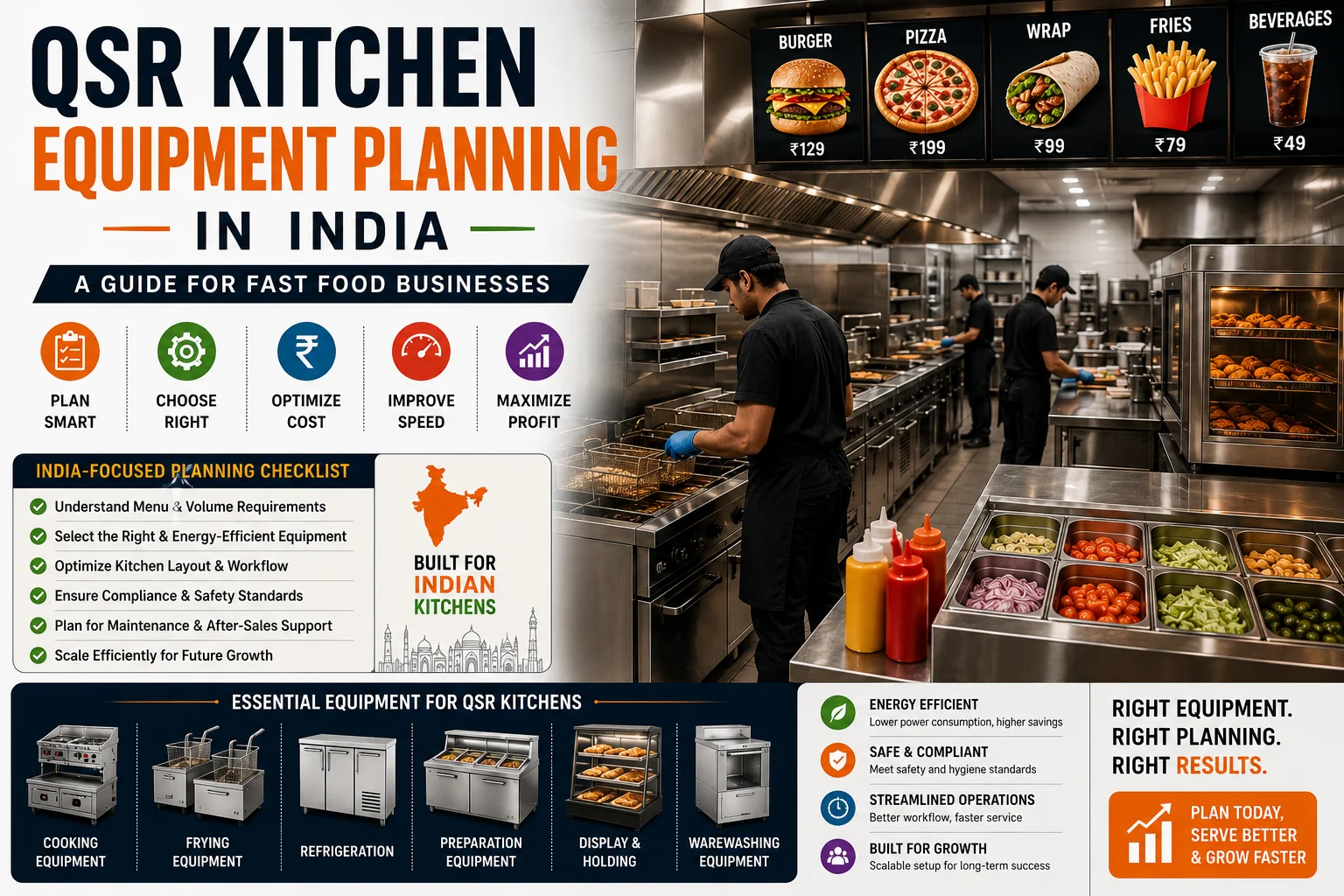
A QSR runs on speed. Customers expect their order within minutes, not the leisurely pace of a full-service restaurant, and that expectation changes almost everything about how a quick service restaurant kitchen should be built, from fryer capacity to where the packing counter sits.
Many first-time QSR owners buy equipment the way they would for any restaurant: pick reliable brands, compare prices, and fill the kitchen. But a QSR kitchen is not a smaller version of a full-service kitchen. It runs on standardized menus, repetitive preparation, and order volumes that spike sharply during peak hours, so equipment that suits a casual dining kitchen can slow a QSR down, while equipment built for a QSR may be unnecessary for a sit-down restaurant.
This guide looks at how QSR operations menu format, food preparation process, order volume, peak-hour demand, and kitchen workflow should shape your QSR kitchen equipment decisions, so you plan a kitchen for how a QSR actually runs, not around a generic checklist.
A Quick Service Restaurant is built around fast order fulfillment with a limited, standardized menu. Customers usually order at a counter or through an app, and food is prepared, assembled, and served within a short window, with little or no table service.
Behind the counter, this shows up as standardized recipes, so every order tastes the same regardless of who prepares it, and preparation is broken into batches ahead of service rather than started from scratch. Order frequency during peak hours can be intense, with several orders arriving within seconds of each other.
For this to work, the kitchen needs a tight workflow. Preparation, cooking, holding, assembly, and packing function almost like a small assembly line. If one station slows down, the whole line backs up. That’s why equipment choices for a QSR kitchen setup can’t be separated from how the kitchen behaves during a rush.
A full-service kitchen is built around a broad menu, made-to-order cooking, and a pace set by table turnover. A QSR kitchen is built around a narrow menu, repetitive preparation, and a pace set by the counter or delivery queue.
The practical differences show up across several areas. Menu structure is narrower in a QSR, which lets equipment be chosen for specific, repeated tasks rather than general-purpose cooking, and preparation leans heavily on batching and pre-portioned ingredients rather than closer-to-order prep. Standardized items need consistent, quick turnaround, so fryers and griddles are built for continuous use rather than occasional cooking, and a handful of machines may run almost non-stop through service instead of usage being spread across a wider equipment set. Order volume also arrives at a higher frequency of smaller tickets, so layout matters as much as kitchen size, and staff tend to work fixed stations since the workflow is linear rather than shifting between stations as order mix demands.
Menu format is the biggest factor in deciding what equipment actually earns its place in a QSR kitchen.
Indian fast food QSRs : vada pav, samosas, or chaat usually need robust frying equipment, hot-holding for prepared snacks, and compact prep counters for chutneys, since items are often fried to order from pre-made bases.
Burger and sandwich QSRs : need a griddle for patties, a toaster or bun warmer, and refrigerated prep counters within arm’s reach for assembly. Speed depends on how close the prep unit sits to the griddle.
Pizza-focused QSRs : built around the oven, but dough handling, sauce stations, and refrigerated topping tables matter just as much, since oven recovery time between bakes affects throughput during a rush.
Fried food QSRs : depend on fryer capacity and oil management, with holding cabinets that keep fried items at serving temperature without drying them out.
Chinese and Indo-Chinese QSRs : rely on high-heat, fast cooking on burners, plus steady prep for sauces and vegetables. Ventilation and burner output matter more here than fryers or ovens.
Multi-menu QSRs : combine formats, such as fast food with beverages, and need to balance equipment across categories without overcrowding a limited footprint, often prioritizing multi-purpose or space-efficient equipment over one machine per task.
The equipment list should follow from what the menu actually requires during service, not a standard template.
Peak-hour demand, not average order volume, should drive capacity decisions. A fryer or griddle that handles a quiet afternoon comfortably can fall behind during a lunch rush if it’s undersized for the order flow.
A few things matter more than exact numbers. Recovery time is one: fryers and griddles need time to return to temperature after each batch, and if that’s too long relative to order frequency, tickets queue up even if the equipment isn’t technically “full.” Preparation and refrigeration capacity is often the real bottleneck, since cooking equipment can only work as fast as prepped ingredients and cold storage allow, and holding capacity matters for menus that batch-cook ahead of orders. Staff productivity factors in too oversized equipment with too few hands to run doesn’t automatically speed things up and if you expect volumes to grow, equipment with some headroom avoids early replacement.
The right approach is to plan capacity around your actual expected peak-hour volume, not a generic industry figure.
Commercial cooking equipment : griddles, ranges, and burners, chosen around your menu’s dominant cooking method and how continuously they’ll run.
Frying equipment : for fry-heavy menus, capacity, oil handling, and recovery speed matter as much as footprint; undersized fryers are a common rush-hour bottleneck.
Commercial refrigeration : under-counter units near prep and assembly reduce staff movement, while larger reach-ins handle bulk storage.
Food preparation equipment : prep tables and portioning tools sized for batch work, since most QSR kitchens prep ahead rather than during service.
Food holding equipment : hot-holding cabinets or bain maries keep batch-cooked items ready for quick assembly.
Stainless steel work tables : placement should follow the prep-to-cook-to-assembly flow, not just fit wherever there’s space.
Trolleys : useful for moving prepped stock between storage and stations when they aren’t adjacent.
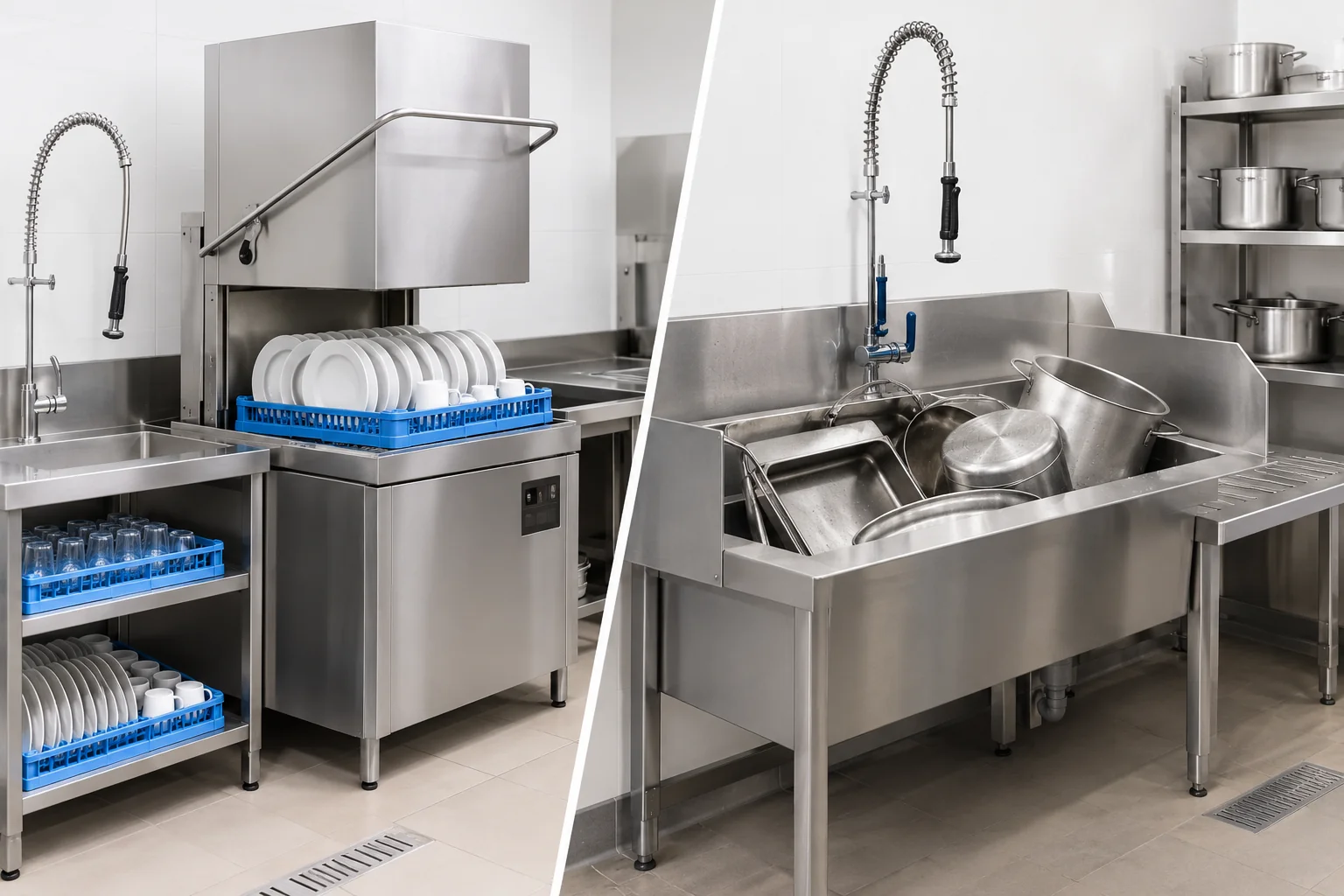
Dishwashing equipment : Even QSRs that primarily use disposable packaging need washing facilities sized to their actual load of reusable utensils, cookware, trays, and cleaning requirements.
Exhaust and ventilation : should match your cooking equipment’s heat and smoke output, particularly for continuous frying.
Display or serving equipment : where relevant, supports order visibility and faster handoff at the counter.
Each category should follow from your menu, space, and order volume, not a fixed checklist.
QSR speed depends as much on layout as on the equipment itself. A logical flow receiving, storage, preparation, cooking, holding, assembly, and packing or serving reduces unnecessary staff movement and stops stations from working against each other.
Receiving and storage work best near the entrance, away from the cooking line, so incoming stock doesn’t cross paths with staff during service. Preparation should sit close to both storage and cooking equipment, minimizing how far ingredients travel, and cooking equipment should feed directly toward holding or assembly rather than sending staff backward through the kitchen. Assembly and packing are where most bottlenecks appear, since several prepped components come together per order keeping toppings and packaging within easy reach cuts time off each ticket. The serving or dispatch point should sit close enough to the assembly that completed orders move out fast.
Cross-traffic between stations is one of the most common workflow problems in QSR kitchens; even well-chosen equipment loses value if it forces staff to double back during a rush.
Many QSRs in India operate in compact spaces, often because rent in high-footfall locations is tied to square footage. In a small kitchen, every piece of equipment has to justify the space it occupies.
Start by separating what’s genuinely essential to your core menu from what’s simply convenient: a focused menu usually needs fewer machines than owners initially assume. Compact models, such as narrower griddles, under-counter refrigeration, or combination units, free up floor space without cutting capacity where it matters. Multi-purpose equipment is worth considering where it genuinely fits the menu, but shouldn’t replace equipment your highest-volume item depends on, and avoiding unnecessary equipment matters as much as choosing the right equipment, since extra machines tend to create clutter rather than help. Aisles still need to be wide enough for safe movement near hot equipment, and it helps to leave a little flexibility if you expect to expand later.
Before finalizing a purchase, check equipment against a consistent set of questions: Does it match what your menu actually requires? Is its capacity realistic for peak-hour volume, not just average traffic? Does it fit your kitchen space without crowding staff movement? What power or fuel type does it need, and is that reliably available? How much energy will it use during continuous operation, and how easy is it to clean and maintain? Are spare parts accessible, and what warranty or after-sales support comes with it? What are the likely long-term operating costs beyond the upfront price, and does it leave room for the business to grow?
Working through these before buying tends to prevent the regrets most QSR owners run into after opening.
Buying on price alone often costs more later through breakdowns, higher energy use, or weak after-sales support. Ignoring peak-hour demand leaves equipment unable to keep up when it matters most, and choosing equipment that doesn’t match the menu, a powerful fryer in a griddle-led kitchen, for instance wastes both space and budget. Oversized equipment in a compact kitchen eats into staff movement space instead of speeding things up, and poor placement can make even well-chosen equipment underperform. Ignoring maintenance needs leads to faster breakdowns under continuous QSR use, overlooking power or fuel requirements can delay installation, and buying only for current volumes can mean early replacement if the business scales faster than planned.
Riddhi Display manufactures and supplies commercial kitchen equipment across categories relevant to QSR operations, including commercial refrigeration, cooking and frying equipment, food preparation and holding equipment, stainless steel work tables, and display counters.
For QSR owners, the equipment decision usually comes down to menu requirements, available space, expected order volume, and how the kitchen needs to flow during service. If you’re setting up a new QSR or upgrading an existing kitchen, you can reach out to Riddhi Display to discuss your requirements and evaluate what fits your operation.
Equipment planning for a QSR kitchen works best when it starts from how the business actually operates the menu, order volume, peak-hour demand, available space, and the workflow connecting preparation to cooking to service. Equipment chosen around these factors tends to hold up better under daily pressure than equipment chosen on price alone. As your QSR grows or your menu evolves, it’s worth revisiting these same questions rather than assuming your original setup will always keep pace.
What equipment is needed for a QSR kitchen in India?
A QSR kitchen typically needs commercial cooking equipment, frying equipment, refrigeration, food preparation equipment, holding equipment, work tables, and dishwashing equipment.
How do I choose commercial kitchen equipment for a QSR?
Choose equipment based on your menu, peak-hour order volume, available kitchen space, workflow, energy use, and maintenance requirements.
What is the most important QSR kitchen equipment?
The key equipment includes commercial cooking equipment, fryers, refrigeration units, preparation counters, food holding equipment, and stainless steel work tables.
How do I plan a QSR kitchen layout?
Plan the kitchen workflow from receiving and storage to preparation, cooking, holding, assembly, and packing to reduce unnecessary staff movement and improve service speed.
What should I consider before buying QSR kitchen equipment?
Consider your menu, equipment capacity, peak-hour demand, kitchen space, power or fuel requirements, energy efficiency, maintenance, warranty, and after-sales support.
Copyright by Riddhi Display. All rights reserved.
Powered by: Icecube Digital