
Have a question? Call us Now
+91 9825072799
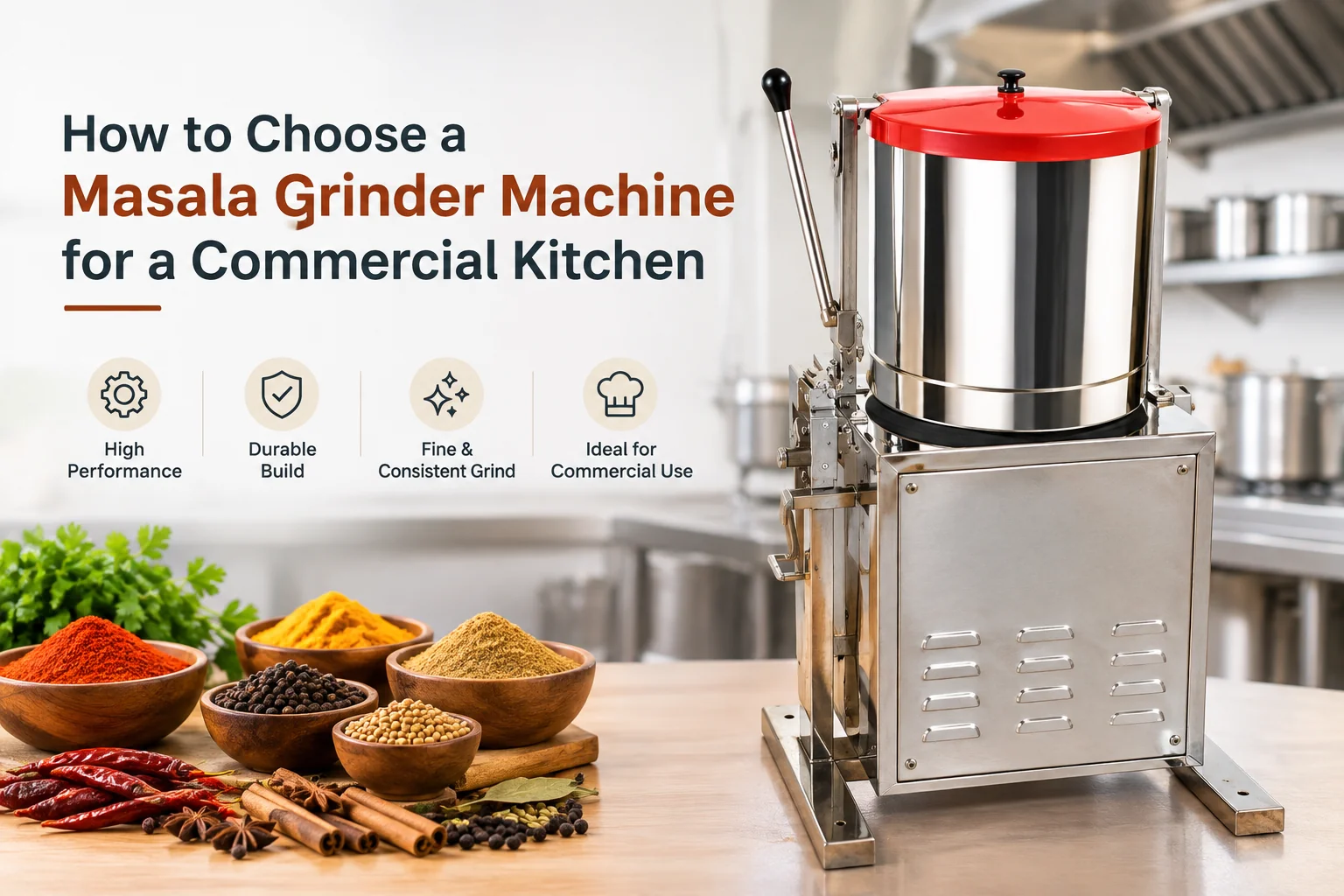
Walk into any busy Indian kitchen at 9 in the morning and you’ll see the same thing. Someone is bent over a pile of red chillies. Someone else is peeling garlic by the kilo. Lunch is three hours away and the masala isn’t ready.
That’s the problem a masala grinder machine solves. But it only solves it if you pick the right one, and that’s where a lot of restaurant owners go wrong. They buy on price, or on whatever the seller says is “best,” and then find out the machine doesn’t suit their food. Let’s sort out how to avoid that.
Forget the machine for a minute and think about your menu.
What do your cooks grind most days? If it’s chilli, coriander, cumin, turmeric and pepper, you’re looking at dry grinding. If it’s ginger-garlic paste, coconut, green chutney or a curry base, you need a wet masala grinder machine. Some kitchens do both and end up needing two different setups.
Whatever you shortlist, read what the manufacturer says the machine is meant to handle. A grinder built for soft, wet ingredients won’t love a load of hard, dry spices, and the reverse is true too.
Here’s the honest answer: it depends, and anyone who gives you a number without asking about your kitchen is guessing.
A small restaurant with a compact menu can get by with a smaller machine. A hotel kitchen or a caterer handling big orders is a different story. What matters is how much masala you go through in a day, how much you make at once, and how many rounds it takes. Space counts too. Commercial kitchens are always tight.
It also pays to think ahead. If you’re planning a second outlet or more catering work, buy for where you’re going, not just where you are today.
Get it wrong in either direction and you’ll feel it. A machine that’s too small means your staff spend the morning loading, grinding, emptying and repeating. One that’s too big eats up counter space and sits half-empty most days. You’ve paid extra for nothing.
Dry grinding is for whole spices and anything without much moisture. Think dried red chillies, coriander seeds, jeera, pepper, haldi. You get a powder. Kitchens that make their own garam masala or chilli powder use this all the time.
Wet grinding is for the moist stuff, like ginger, garlic, coconut, fresh herbs and soaked spices, and it usually needs a bit of water. You get a paste. That paste is the starting point for most gravies, marinades and chutneys.
If you need both, ask the supplier a direct question: can this one machine do both jobs properly, or should I buy two? It’s a fair thing to ask. Dry chilli powder and oily wet paste don’t always share a chamber happily, and cleaning between them takes effort.
Don’t just compare prices. Compare what you’re actually getting.
Motor power. A kitchen that runs the machine for long stretches needs a stronger motor than one that grinds a little each morning. But wattage alone tells you very little. Look at the rated capacity and the ingredients the machine is designed for.
Capacity. Match it to your normal batch. Big batches every day? Go for higher capacity and you’ll save time. Smaller kitchen? A compact one is easier to fit in and easier to manage.
Build quality. This machine will work hard, day after day. Look at what the grinding chamber and other food-contact parts are made from. Food-grade stainless steel is the usual choice, and there’s a reason for that.
Cleaning. This one gets underrated. Masala is sticky and oily, and chilli powder gets into every gap. If the machine is a nightmare to open up, your staff will cut corners. And after a turmeric batch, nobody wants yellow specks turning up in a white chutney. Ask how easily it comes apart.
Texture. A dry sabzi masala can be coarse. A korma paste needs to be silky. Check that the machine gives you the finish your main dishes need, because consistent texture is what keeps your food tasting the same from day to day.
Safety. Look for a stable body, covers that lock properly and controls that are easy to reach. Then show your staff how to use it, clean it and switch it off properly. A machine is only as safe as the person operating it.
Warranty and service. Ask what’s covered, whether spare parts are easy to get, and who picks up the phone when something goes wrong. If your grinder stops in the middle of the week, you want it fixed quickly, not in a fortnight.
| Factor | What to Consider |
|---|---|
| Grinding Type | Wet, dry or both, depending on your ingredients |
| Capacity | Match the machine with your regular batch size |
| Motor Power | Choose according to daily workload and usage |
| Build Quality | Look for durable, food-grade construction |
| Cleaning | Check how easily the grinding chamber can be cleaned |
| Texture | Make sure it delivers the consistency your recipes need |
| Safety | Look for stable construction and secure covers |
| Warranty & Service | Check warranty, spare parts and after-sales support |
A traditional masala grinder still has its place, especially for small quantities or if you like the old-school way of doing things. If you’re making large amounts daily and need speed and consistency, a modern commercial machine will usually serve you better.
Either way, bigger isn’t automatically better. A huge, powerful machine that’s far beyond what you need is just a costly way to be inefficient. Look at your workload, ingredients, batch size, space, cleaning routine and budget, then decide.
Most Indian dishes start with a masala of some kind. It might be a spice powder, a paste, a marinade or a gravy base. Without it, service falls apart.
Take a dinner rush that starts at 7. The cooks need masala ready before the first order comes in. If someone is still grinding small batches at 6:30, everything else gets pushed back. A machine that suits your volume means you’re ready before service starts, not scrambling during it.
Caterers deal with volume and deadlines. A wedding or a corporate lunch might need large amounts of spice blends, curry bases, chutneys and marinades, often prepared the day before.
A good grinder makes that far easier, as long as it fits your order sizes. Think about your average order, how many batches you’ll run, what you’ll be grinding, how much workspace you have and how often you’ll use it. Nobody wants to be grinding endless small batches at midnight before a big event.
Used properly, it speeds up prep, makes big batches simpler, gives you more consistent results on recipes you repeat and cuts down on manual grinding. It’s built for daily use and can handle a wide range of Indian preparations.
Just remember that all of this depends on choosing a machine that suits your kitchen. The wrong one delivers none of it.
A few habits make a real difference, whatever machine you end up with.
Dry your chillies and whole spices properly before dry grinding, since damp ingredients clog things up. Don’t overload the chamber. Grind in sensible batches instead of cramming it full. Give the machine short breaks during long runs so it doesn’t overheat. Grind in an area with decent ventilation too, because chilli dust is nobody’s friend. And clean it properly between strong-smelling and mild ingredients, so flavours don’t cross over.
What do we grind most often? Do we need wet, dry or both? How much per batch, and how many batches a day? How much space do we have? Is it easy to clean? What does the warranty cover? Will it still work if we grow?
| Your Kitchen Requirement | What to Look For |
|---|---|
| Mostly dry spices | A grinder designed for dry grinding |
| Ginger, garlic, coconut or chutneys | A suitable wet grinder |
| Both wet and dry ingredients | Check whether one machine supports both applications |
| Small daily batches | Compact capacity may be sufficient |
| Large daily batches | Higher-capacity commercial equipment |
| Limited kitchen space | Compact design with suitable capacity |
| Frequent daily use | Durable construction and reliable motor |
| Growing business | Choose capacity that can handle future workload |
Answer those honestly and the decision gets much easier. You’ll be comparing machines on what your kitchen needs, not on which one has the biggest number on the spec sheet.
Choosing the right masala grinder machine starts with understanding your kitchen’s actual requirements. Consider the ingredients you process, your batch size, daily workload, available space and the type of grinding you need. Then compare capacity, motor power, build quality, cleaning, safety, warranty and service support.
For Indian restaurants, hotels, caterers and cloud kitchens, the right grinder can make everyday preparation more efficient and consistent. Riddhi Display supplies commercial kitchen equipment for businesses setting up, expanding or upgrading their kitchen operations.
What type of masala grinder machine is suitable for commercial use?
It depends on what you grind, how much you make per batch and how busy your kitchen is. Choose the machine that matches those, not just the biggest one.
What capacity does a restaurant need for a masala grinder machine?
That comes down to your daily production and batch size. Small restaurants can usually manage with a compact machine, while larger kitchens and caterers need more capacity.
What is the difference between wet and dry grinding?
Dry grinding turns whole spices and dry ingredients into powder. Wet grinding makes pastes from moist ingredients like ginger, garlic, coconut and fresh herbs.
What should you check before buying a masala grinder machine?
Look at capacity, motor power, grinding type, build quality, ease of cleaning, safety features, warranty, spare parts and service support.
Is a wet masala grinder machine suitable for restaurants?
Yes. It works well for curry pastes, chutneys, marinades, ginger-garlic paste and other wet masala preparations.
Copyright by Riddhi Display. All rights reserved.
Powered by: Icecube Digital