Have a question? Call us Now
+91 9825072799
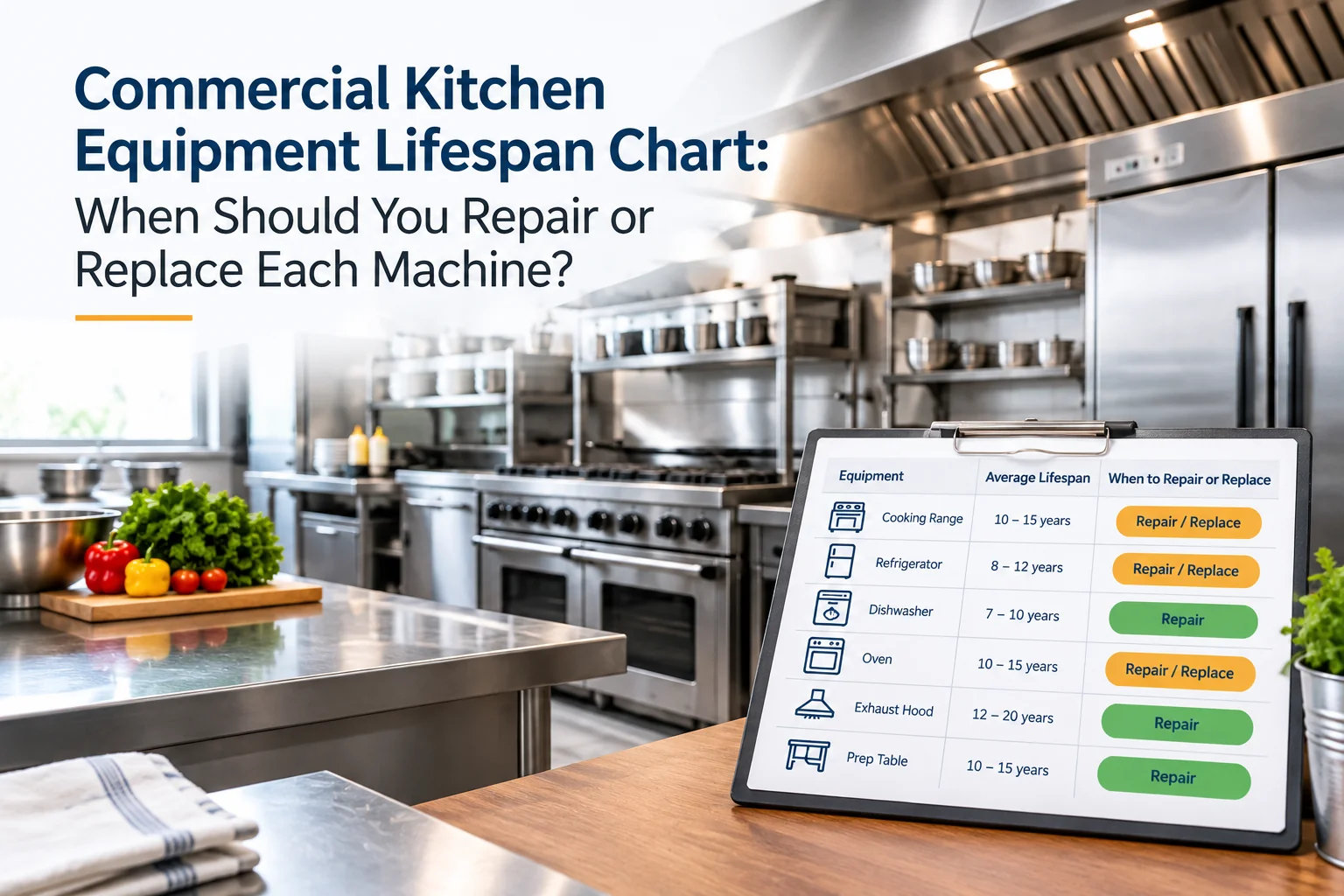
Restaurants, hotels, cafes, bakery, and cloud kitchen would not be considered without commercial kitchen equipment, as it is one of the most essential investments they make! Whether it’s refrigeration units, cooking ranges, ovens, fryers or display counters, each machine contributes to the smooth running of the day. Commercial kitchen equipment, however, is like any other piece of equipment in business has a finite life.
A restaurant owner’s biggest problem is to decide on replacement of the existing equipment or repair it using a new model. Although repairing a machine might be a cost-effective solution, its frequent breakdowns, rising maintenance costs, energy consumption and performance loss can have an impact on profitability in the long term.
Knowing your commercial kitchen machine life cycle will enable restaurant operators to manage maintenance rotas, operating costs and equipment breakdowns. This Commercial Kitchen Equipment Lifespan Chart provides details on the duration of the life of some of the most common pieces of restaurant equipment and when replacement is more cost effective than repair.
| Equipment | Average Lifespan | When Replacement Should Be Considered | Maintenance Frequency |
|---|---|---|---|
| Commercial Refrigerator | 10–15 Years | Frequent cooling problems, rising electricity costs, compressor failure | Every 3–6 months |
| Commercial Freezer | 10–15 Years | Poor temperature control and repeated repairs | Every 3–6 months |
| Pizza Oven | 12–20 Years | Uneven heating and reduced cooking efficiency | Every 6 months |
| Commercial Cooking Range | 12–18 Years | Burner issues, gas leakage, frequent repairs | Every 6 months |
| Deep Fryer | 8–10 Years | Slow heating and increasing oil consumption | Monthly cleaning and servicing |
| Combi Oven | 10–15 Years | High repair costs and performance issues | Quarterly maintenance |
| Dishwasher | 8–12 Years | Poor cleaning performance and water efficiency problems | Every 3–6 months |
| Exhaust Hood System | 15–20 Years | Reduced airflow and ventilation issues | Regular cleaning |
| Display Counter | 10–15 Years | Cooling failure and poor product presentation | Quarterly servicing |
The conditions that restaurant equipment must operate under are much more harsh than those of residential appliances. A commercial refrigerator could be used year round, and cooking equipment is subjected to constant heat, grease, and heavy use.
Even the best equipment can lose efficiency at a much more rapid rate than is anticipated without proper maintenance. An inefficient refrigerator can lead to more food waste, and an ineffective cooking range can be a productivity drag during peak hours in the kitchen.
With an understanding of commercial kitchen equipment life expectancy, restaurant owners can avoid the “last minute” breakdowns and make informed decisions about their equipment.
When the problem is limited to a particular part of the equipment, and the equipment has a serviceable life left, it is often the best solution to repair the equipment. So, if there is a broken thermostat in a refrigerator, a broken burner in a cooking range or a small electrical component in the refrigerator then it is possible that the performance can be restored without a huge investment of money.
Regular servicing also plays an important role in extending equipment life. Professional inspections can detect minor issues before they become costly repairs. Commercial kitchen equipment preventive maintenance can enhance efficiency, minimize downtime and help safeguard your investment.
But, ongoing repairs can add up over the years. Some machines may need frequent repair or replacement parts may be hard to obtain, so purchasing new equipment may be more beneficial in the long run.
Many restaurant owners wait until equipment is 100% broken before replacing. This can actually cause some unforeseen issues, particularly during high traffic periods. A key indicator is rising repair rates. Expensive machinery that is making repeated repairs in a short time can end up costing more than the machine.
Increased energy costs is another sign that replacement might be needed. An older refrigerator, freezer or cooking appliance may use more electric power or gas than new energy efficient appliances. Likewise, substandard performance may indicate that equipment is at its end-of-life. Cooking temperatures may be uneven, cooling is slow, unusual noises may occur or operations may be inconsistent, all of which can contribute to the quality of foods and customer satisfaction.
Never disregard safety concerns. Any equipment that has damaged electrical components, gas problems or has poor ventilation performance should be checked for right away and replaced if needed.
Increased longevity in commercial kitchen equipment is one of the best ways to implement preventive maintenance. Cleaning, inspection and servicing work regularly to help prevent unexpected failures and maximize overall performance. To ensure efficient cooling, clean condenser coils and make sure temperature settings are correct for refrigeration equipment.
Burners, heating elements and controls should be checked on a regular basis on cooking equipment for consistent performance. Ventilation system, such as exhaust hood and blowers, should also be cleaned regularly to eliminate grease accumulation and ensure good airflow.
A professional maintenance schedule can help the restaurant owner save money and avoid expensive emergency repairs by letting them know if the issue is a problem in advance.
The durability and efficiency of commercial kitchen equipment is directly correlated with the quality of the equipment. A lower initial cost may be achieved with cheaper machines, but these can be more prone to breaking down and may be consuming more energy. When it comes to spending money on long-lasting commercial kitchen equipment that will be efficient in the long term, it may be better to invest in durable, high-quality items from a trusted commercial kitchen equipment supplier.
Heavy load restaurant machines are generally high quality and offer better service support and spares availability. It is important for restaurant owners to take into account the lifetime value of the equipment, maintenance expenses, energy consumption, and more, and not just the price of the purchase.
Commercial kitchen equipment is a long-term investment that directly affects restaurant efficiency, food quality, and operational costs. Knowing the expected lifespan of commercial kitchen equipment helps business owners plan repairs, replacements, and regular maintenance more effectively.
Instead of waiting for equipment failure, restaurant owners should regularly evaluate equipment performance, repair expenses, and energy efficiency. A proactive approach to commercial kitchen equipment maintenance ensures smoother operations and helps prevent unexpected disruptions. By choosing reliable commercial kitchen equipment from a trusted supplier like Riddhi Display and following a proper maintenance plan, restaurants can extend equipment lifespan, reduce unnecessary expenses, and create a kitchen environment built for long-term success.
Commercial kitchen equipment typically lasts 8 to 20 years, depending on the equipment type, usage, quality, and maintenance.
2. When should commercial kitchen equipment be replaced?
Replace commercial kitchen equipment when it has frequent breakdowns, high repair costs, rising energy consumption, or declining performance.
3. Should I repair or replace commercial kitchen equipment?
Repair equipment when the issue is minor and repair costs are reasonable. Replacement is better when breakdowns are frequent or repair costs continue to increase.
4. How can I extend the lifespan of commercial kitchen equipment?
Regular cleaning, preventive maintenance, timely repairs, and proper operation can help extend the lifespan of commercial kitchen equipment and reduce unexpected breakdowns.
5. Which commercial kitchen equipment needs regular maintenance?
Refrigerators, freezers, ovens, cooking ranges, fryers, dishwashers, exhaust systems, and display counters need regular maintenance for efficient and reliable operation.
Copyright by Riddhi Display. All rights reserved.
Powered by: Icecube Digital