Have a question? Call us Now
+91 9825072799
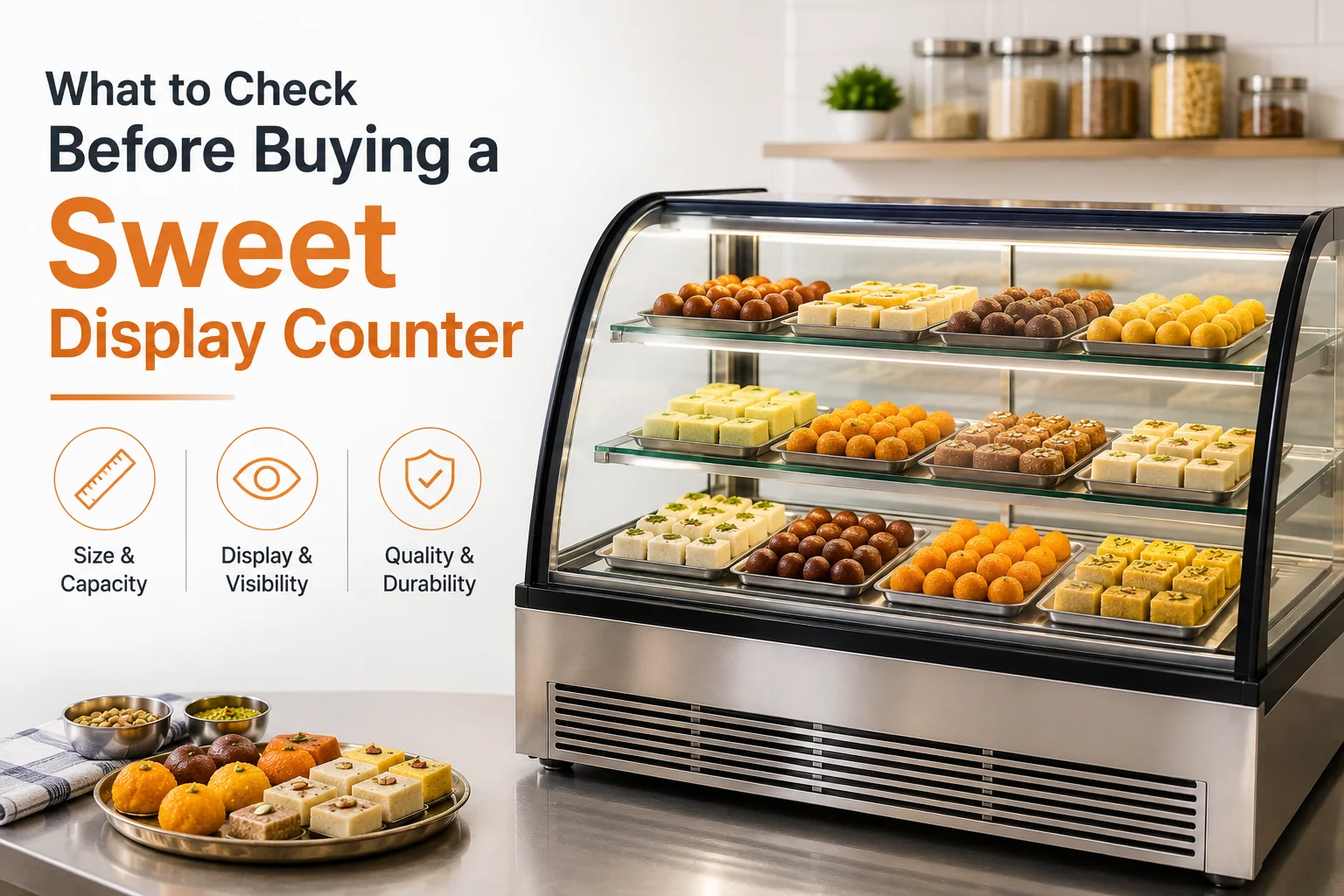
Anyone who has walked into a good mithai shop knows the pull. The trays are neat, the lights make the barfi glow, and you suddenly want a box of everything.
That effect does not come from the sweets alone. It comes from the counter they sit in. A sweet display counter that cools unevenly, fogs up in the afternoon or blocks the view of the back rows will quietly cost you sales every day, and you may never notice why.
Before you pay for one, there are a few things worth checking. This guide goes through them in the order that matters, so you can buy once and buy right.
Every other decision depends on this one. Sweets are not all the same, and a counter that suits one type can spoil another.
Dairy-based sweets such as rasgulla, rasmalai, kalakand, milk cake and fresh peda need cooling. Left at room temperature, they turn sour faster than most owners expect, especially in Indian summers.
Dry sweets like kaju katli, soan papdi, laddoo and chikki do better in an ambient counter. Too much cold can make them sticky or hard.
Fried and syrup sweets such as jalebi and gulab jamun sit somewhere in between, depending on how fast you sell them and how hot your shop gets.
Cream cakes and pastries, if you sell them alongside mithai, need proper refrigeration.
Write down your top ten selling items and sort them into cold, ambient and warm. If most of your menu falls in one group, buy for that group. If it is split evenly, you may need two units, or one counter with separate zones.
This is the check most buyers skip, and it is the one that causes the most wasted stock.
Some counters are cold at the top shelf and warm at the bottom, or the reverse. In a showroom with the air conditioning on, you will never notice. In your shop, with the door opening a hundred times a day, the difference shows up fast.
Dairy-based sweets should sit in the range of roughly 2°C to 8°C. Ask the supplier how the unit spreads cold air, and if you can, put a separate thermometer on the lowest shelf during a trial run. The temperature panel on the front only tells you what the sensor sees, not what your sweets feel.
If you plan to sell cold desserts and cakes as well, take a look at our refrigerated display counters to understand how cooling and shelf layout work together.
A counter that looks right in a photo can become a problem once it is inside your space. Measure before you do anything else.
Floor space. Note the width and depth of the spot, then leave room for staff to move behind the counter and for customers to queue in front. A counter that squeezes the walkway will slow service every single day.
Shelf depth. Deep shelves hold more, but if staff cannot reach the back, that space is wasted. Match the depth to your tray sizes.
Height. Customers should see the top row without stretching, and children should still see something interesting.
Entry path. Check doors, lifts and corridors. A big counter that cannot enter the shop is an expensive mistake.
If you sell cakes and pastries too, you might prefer a layout shared with your bakery display counter, so the whole shop looks like one planned space instead of a mix of unrelated units.
Customers buy what they can see, so glass quality is not a cosmetic detail. Three things matter.
It should be tempered. This makes it stronger and safer, which matters when staff are opening and closing doors all day.
It should resist fogging. Foggy glass hides your best sweets. If your shop is in a humid area, ask specifically how the unit prevents condensation on the front panel.
It should be clear from every angle. Curved glass looks premium and gives a wider view, but it costs more to replace. Straight glass is simpler and easier to repair. Pick based on your budget and the look you want, not on what seems more impressive.
Also check the door type. Sliding doors save space, while lift-up doors give easier access but need clearance. For a busy counter with heavy footfall, smooth sliding doors with strong tracks tend to hold up better.
Lighting changes how your sweets look more than most owners realise. The same tray of barfi can look fresh and rich under good light or flat and dull under bad light.
LED lighting is the usual choice because it shows colour well and does not give off much heat. Heat matters because warm lights near dairy sweets can speed up spoilage and make the cooling system work harder.
Ask whether the lights are placed to cover every shelf, or just the top. Dark lower shelves mean your lower-row sweets sell less, because people simply do not notice them.
A counter is a long-term purchase, so the body matters as much as the glass.
Stainless steel is the standard for food counters because it resists rust, wipes clean easily and handles daily wear. Ask which grade is used. Food-grade stainless steel holds up far better against moisture and cleaning chemicals than cheaper metal.
Check the joints too. Weak assembly shows up after a year of heavy use, when doors start to sag and panels loosen. A well-built unit stays tight even after thousands of open-and-close cycles.
| What You Sell | Counter Type | Key Thing to Check |
|---|---|---|
| Rasgulla, rasmalai, milk sweets | Refrigerated | Even cooling on every shelf |
| Kaju katli, laddoo, soan papdi | Ambient (dry) | Stable room-level temperature, no excess cold |
| Cakes and cream pastries | Refrigerated | Humidity control, shallow trays |
| Jalebi, hot snacks | Heated | Temperature stays safe above 60°C |
| Mixed menu | Multi-zone or two units | Separate temperature areas |
| Packaged sweets and gift boxes | Ambient with adjustable shelves | Easy restocking and clear labels |
If you also sell savoury items alongside sweets, it can help to look at a matching namkeen display counter so both sections look consistent.
A display counter runs from opening to closing, every day. Even a small difference in power use adds up over a year.
Look for good insulation, efficient cooling and LED lighting. These three things together keep running costs down. Cheaper units often skip insulation, and you end up paying for it every month on your electricity bill.
Ask the supplier about typical power use, and compare it between models rather than just picking the lowest price.
A good manufacturer should answer these without hesitation.
When you compare each sweet display counter supplier, look at these answers alongside the price. The cheapest quote often leaves out installation, transport or lighting.
Price depends on size, cooling type, glass shape, finish and customisation. A straight, standard unit costs less than a curved, custom-built one with multiple zones.
Rather than hunting for the lowest number, think about the cost over several years. A well-insulated, sturdy counter with good service support usually costs less over time than a cheap one that needs repairs. For a rough sense of typical ranges before you start collecting quotes, the display counter pricing guide is a useful starting point.
If you are setting up the full shop at the same time, it also helps to plan your display and back-of-house together. Our commercial kitchen equipment range covers the production side, so your counter and kitchen work as one system.
A sweet display counter is one of the few purchases that works for you every minute your shop is open. Check what you sell, how evenly it cools, how clear the glass stays, whether the size fits your space, and how well the supplier supports you after installation. Do that, and you avoid most of the problems that shop owners regret later.
If you are ready to compare options, Riddhi Display offers a wide range of sweet display counters in different designs and sizes, built for sweet shops, bakeries and food outlets. You can explore the full sweet display counter collection or request a free quote to find the right unit for your shop.
1. What is a sweet display counter used for?
A sweet display counter stores and shows sweets, desserts and confectionery while keeping them fresh and attractive for customers.
2. Do all sweets need a refrigerated counter?
No. Milk-based sweets need cooling, while dry sweets like kaju katli and laddoo do well in an ambient counter.
3. Can a sweet counter be customised?
Yes. Size, design, glass type, lighting, shelving and branding can usually be adjusted to suit your shop.
4. What materials are best for a sweet counter?
High-grade stainless steel with tempered glass is the usual choice, since it is durable, hygienic and easy to clean.
5. Are sweet display counters energy efficient?
Modern units use better insulation, efficient cooling and LED lighting to keep power use down.
Copyright by Riddhi Display. All rights reserved.
Powered by: Icecube Digital