Have a question? Call us Now
+91 9825072799
Walk into any busy bakery and you’ll notice the same thing: people buy with their eyes first. A cake that sits under good light, at the right temperature, with a clean glass front will sell faster than the same cake tucked behind a dull, fogged-up case.
That is why picking the right cake display counter is not a small purchase. It affects how fresh your products stay, how easily your staff can serve, and how much customers want to buy. This guide walks you through what to look at, what to skip, and what to ask before you pay.
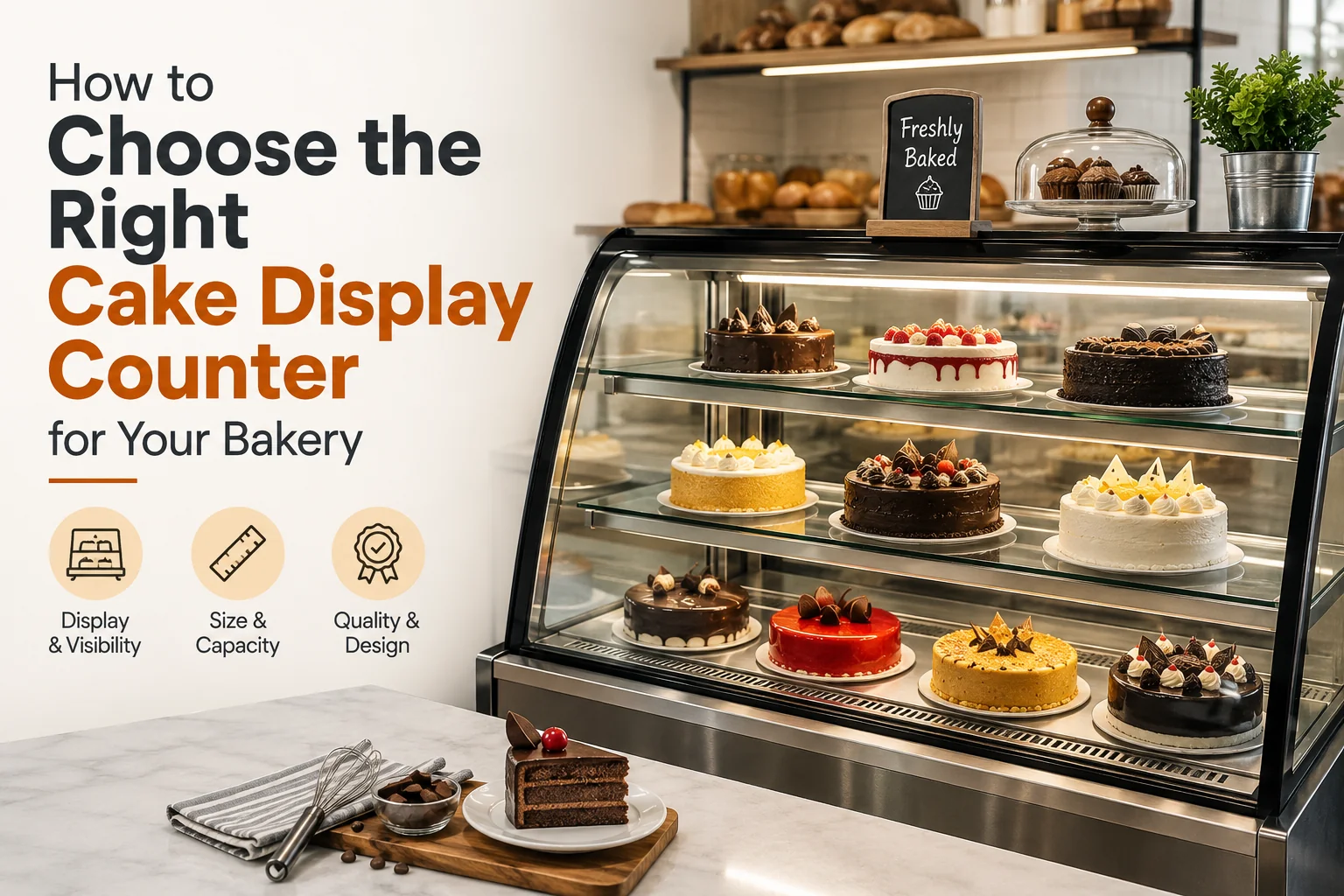
A cake display counter is a glass-fronted unit built to hold cakes, pastries and desserts so customers can see them while the products stay protected. Most are refrigerated, with LED lighting and shelves sized for cake boxes, trays and slices.
It matters for three reasons. First, it keeps cream and custard items safe and fresh. Second, it acts as your silent salesperson, since the way products are arranged and lit nudges people to add one more item to their order. Third, it sets the tone for your shop. A clean, well-built bakery display counter tells customers you care about quality before they taste anything.
Most bakery counters fall into a few common formats. The right one depends on your products, your shop layout and how you serve customers.
| Counter Type | Best For | Main Advantage | Things to Consider |
|---|---|---|---|
| Straight glass | Small to mid-size cake shops | Clear view, easy to clean, fits against a wall | Takes up a fixed length of counter space |
| Curved glass | Premium bakeries and cafés | Wide viewing angle, modern look | Costs more to repair if the glass breaks |
| L-shaped | Corner spots or shops with separate billing | Shows products on two sides | Corner joint needs regular cleaning |
| Dry bakery counter | Bread, cookies, puffs, biscuits | No refrigeration cost | Not suitable for cream-based items |
| Refrigerated cake display | Cakes, pastries, mousse, cheesecake | Keeps cream products fresh and safe | Needs ventilation and a stable power supply |
| Multi-tier display | Pastry-heavy shops | Shows more variety in less floor space | Top shelves can be hard for shorter customers to see |
If you sell a mix of products, many shop owners run one refrigerated unit for cakes and a dry counter for baked goods. It costs a bit more upfront but protects each product better.
Choose refrigerated if you sell anything with cream, custard, fresh fruit, mousse or cheese. Choose dry if you sell bread, cookies, rusks, plain cakes or items that stay fine at room temperature.
A refrigerated bakery counter does more than keep things cold. Good ones control airflow so cut cakes don’t dry out at the edges. Poorly designed units blow cold air straight onto the product, and you end up with cracked icing and stiff sponge by evening.
If you’re opening a new cake shop, a refrigerated unit is almost always the safer starting point. You can add a dry counter later. For a closer look at cooling options, see our range of refrigerated display counters.
Don’t pick a size based on how the unit looks in a photo. Start with your floor plan and your daily sales.
Measure the space first. Note the width, depth and height of the spot, then add room for staff to move behind the counter and for customers to queue in front. A counter that technically fits but blocks the walkway will slow your service every single day.
Think about your product mix. Whole cakes need taller shelves, while pastries and slices work better on shallow trays. If you sell a lot of cake boxes for pre-orders, make sure the shelf depth can handle standard box sizes.
Plan for growth. If you expect your menu to grow in the next year or two, going slightly larger now is cheaper than replacing the unit later. But don’t overbuy either. A half-empty counter looks neglected and wastes electricity.
Many cake display counter manufacturers will build to custom dimensions, which is worth asking about if your shop has an unusual layout.
Here’s what separates a counter that lasts ten years from one that gives trouble in two.
Stainless steel body. 304-grade stainless steel resists rust and is easy to wipe clean, which matters in a food business where hygiene gets checked.
Tempered glass. It’s stronger than regular glass and safer if something hits it. Anti-fog glass is also worth considering in humid cities.
LED lighting. LEDs show off colour without adding heat, so your frosting stays firm and your electricity bill stays lower.
Adjustable shelves. You will change your menu with seasons and festivals. Shelves that move make that easy.
Easy-access doors. Sliding or lift-up doors at the back should open smoothly, since your staff will use them hundreds of times a day.
Clear drainage. Condensation has to go somewhere. Ask how the unit handles water, because a blocked drain is a common headache.
Strong build quality. In a busy shop, the doors open and close all day. Look for tight seals and solid hinges that won’t loosen over time.
For most cake and pastry products, a range of 5°C to 8°C works well. Cream-heavy items like fresh cream cakes, custard tarts and mousse do best at the colder end of that range.
Don’t judge by the display panel alone. Place a separate thermometer on a middle shelf and check it after a busy hour, because temperature rises every time the door opens. If your counter struggles in summer, the unit may be too small for your shop or placed too close to a heat source like an oven or direct sunlight.
This is where many shop owners rush and regret it later. A few simple checks can save you a lot of money.
If you’re also planning your wider shop setup, reading a bakery setup pricing guide helps you budget the counter alongside ovens, mixers and storage.
There is no single price, because cost depends on size, glass type, refrigeration system, finish and how much customisation you need. A straight, standard-size unit costs less than a curved-glass, custom-built one.
The smarter question is cost over time. A slightly higher-priced counter with better insulation uses less power, needs fewer repairs and looks good for longer. Over five or six years, that usually beats a cheaper unit that needs fixing every few months. For a rough idea of ranges, the display counter pricing guide is a good starting point.
The right cake display counter pays for itself through fresher products, faster service and better-looking sales. Measure your space, match the counter type to what you sell, check the build quality, and choose a manufacturer who will still answer your call after installation.
If you’re ready to compare options, you can explore our full range of bakery display counters or request a free quote for a model that fits your shop.
1. What is the best display counter for a cake shop?
For most cake shops, a refrigerated straight or curved glass counter with LED lighting and adjustable shelves is the best choice. It keeps cream cakes safe and shows them clearly.
2. Can a bakery display counter be customised?
Yes. Most manufacturers can adjust size, shelving, lighting, glass shape and finish to suit your shop layout and branding.
3. How often should I clean my cake display counter?
Wipe the glass and shelves daily, and do a deeper clean once a week. Clean the condenser area regularly too, since dust build-up makes the unit work harder.
4. Do I need a refrigerated counter for all bakery items?
No. Bread, cookies and plain baked goods can sit in a dry counter. Cakes and pastries with cream or custard need refrigeration.
Copyright by Riddhi Display. All rights reserved.
Powered by: Icecube Digital