Have a question? Call us Now
+91 9825072799
Dishwashing is a highly important activity in commercial kitchens, whether it is in restaurants and hotels, or catering company. Clean kitchen not only guarantee food safety and hygiene but also influences its operation efficiency, staff performance, and customer satisfaction.
Dishwashers in the commercial industry are specifically designed to deal with large volume dishwasher, therefore it is easy to maintain the cleanliness standards with saving of time and labor. These machines are fast, durable and heavy duty unlike home dishwashers.
In this blog, we will understand commercial dishwashers; their types, their main features, advantages and common mistakes to avoid.
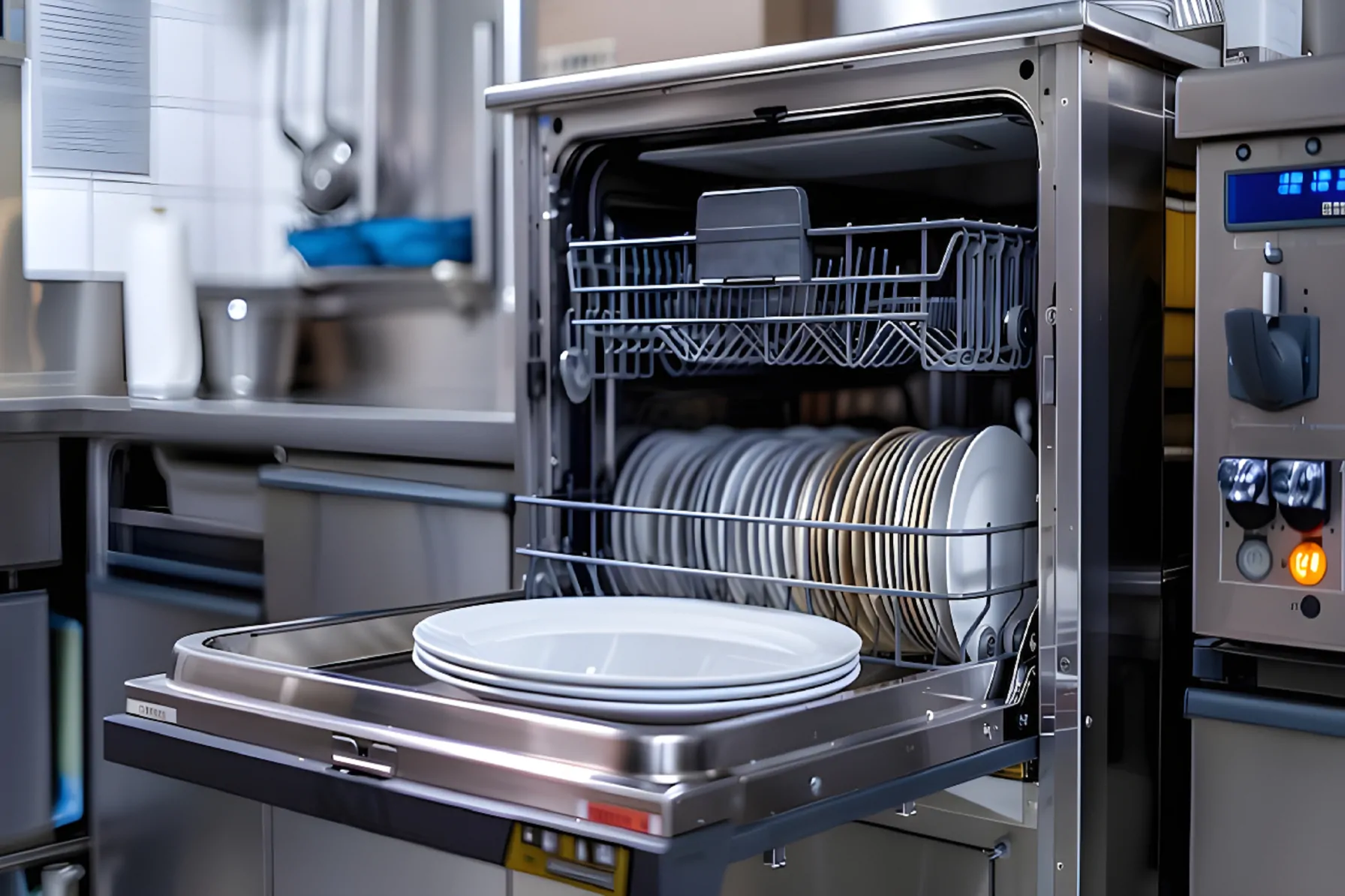
Commercial dishwasher is a high capacity cleaning device used in a professional kitchen. It helps in washing, rinsing, and sanitizing dishes, utensils, and cookware within a short time. It is setup by considering high hygiene standards.
1. Undercounter Dishwashers
Undercounter dishwashers are small machines that fit under a counter and are therefore suitable in small kitchens, cafes or bars with limited space. They work like the residential dishwashers and are stronger and designed to be used in a commercial setting.
Benefits of Undercounter Dishwashers
2. Conveyor Dishwashers
Conveyor dishwashers are medium-large machines that have a conveyor belt system to transport dish racks through various washing, rinsing and sanitizing processes. They are suitable in restaurants, hotels and catering business with large volumes of dishes.
Benefits of Conveyor Dishwashers
3. Door Type Dishwashers (Hood Type)
Door or hood dishwashers have a lift-up hood, or lid, into which the racks are placed. They are also all-purpose and can manage medium-large volumes in the kitchen and are found in restaurants, cafeterias, and catering kitchens.
Benefits of Door Type Dishwashers
4. Flight-Type Dishwashers
Flight-type dishwashers are high capacity continuous-pass dishwashers that are suitable in large setups such as hotels, hospitals and catering facilities. On a flight conveyor system, the dishes rotate endlessly through the machine and thousands of items can be washed in an hour.
Benefits of Flight-Type Dishwashers
| Expert Insight All commercial dishwashing equipment ensures high hygiene standards and durability. |
| Aspect | Household Dishwasher | Commercial Dishwasher |
|---|---|---|
| Capacity | Small, handles 8–12 place settings | Large, handles 50–500+ dishes per cycle |
| Cycle Time | 1–2 hours per cycle | 1–10 minutes per cycle |
| Durability | Designed for occasional use | It is built for continuous, heavy-duty operation |
| Sanitization | It involves basic cleaning; usually no high-temp sanitization | High-temp wash (up to 180°F/82°C) or chemical sanitization |
| Design & Layout | Compact, fits under counters | Multiple types: undercounter, conveyor, hood, flight-type |
| Energy & Water Use | Moderate, household-level efficiency | Advanced energy and water-saving features |
| Ease of Use | Simple interface, few settings | Requires trained staff; advanced controls and automation |
| Maintenance | Minimal; occasional cleaning | Regular maintenance required; self-cleaning and filter systems in some models |
| Cost | $300–$1,000 | $2,000–$50,000+ depending on type and capacity |
| Speed & Efficiency | Slower cycles, manual loading | Rapid, automated cycles with high throughput |
The choice of a suitable commercial dishwasher will create a significant difference in efficiency, hygiene and beneficial economy in a professional kitchen. The following are the steps to use in order to make the best decision:
Kitchen Size and Plan
Find out the space, kitchen routine, and type of dishwasher. This helps in selecting the size of your dishwasher that fits properly. Undercounter machines are not big and can be installed in a small kitchen, unlike other dishwashers like the conveyor or the flight type, which require more space.
Assess Dishwashing Volume
Determine how many dishes, trays and utensils can be washed within an hour or a day. The significance of it lies in the possibility of having large volume kitchens that might need flight-type or conveyor dishwashers, and smaller bars or cafes may use undercounter ones.
Type of a Dishwasher
Choose commercial dishwashing machines based on your preferences. This helps to achieve efficiency and cost savings.
Common Types:
Water & Energy Efficiency
Find commercial dishwashers with Energy Star or water-saving technology. It will conserve power and reduce carbon footprint and make activities sustainable.
Check Clearance and Perform Cycles
You need to evaluate wash temperature, high-temp and chemical sanitization, as well as multi-stage wash programs. This aids in making sure that it is hygienically cleaned as it is part of the health regulations.
Ease of Use and Automation
Newer machines may include touch screens, sensing devices, the automatic dose of the detergent, and programmable cycles. It assists in eradicating human errors, time saved by employees and the quality of cleanliness is maintained.
Maintenance and Durability
Purchase machines with self cleaning, replaceable filters and commercial grade like stainless steel. This reduce downtime, maintenance cost and extends its lifecycle.
Ergonomics and Safety Features
Facilities such as anti-slip floors, insulated doors, and easy-to-lift racks help in protecting the staff. The reason is that it offers a healthy working environment, reduces incidences of injury, and enhances efficiency of the employees.
Budget and ROI
Assess labor, water, energy, and maintenance initial and long-term savings. A higher upfront cost may be efficient and long-lasting machines will tend to be profitable in the long term because of expense savings and improved workflow.
Warranty and Service Support
Test warranties of manufacturer and local service technicians. This ensures easy repairs, reduced downtime, and smooth operations of commercial kitchens.
| Mistake | What It Means | Impact / Consequence |
|---|---|---|
| Wrong Dishwasher Type | Choosing a machine that doesn’t fit your kitchen size or dish volume | Slower operations, workflow bottlenecks, and reduced efficiency |
| Ignoring Energy & Water Efficiency | Overlooking machines with Energy Star or water-saving features | Higher utility bills and negative environmental impact |
| Poor Cleaning Performance | Not considering wash temperature, sanitization type, or cycle variety | Foods can be left unsanitized and they can even not pass health inspections. |
| Skipping Maintenance | Failure to clean filters, self-clean or check up. | More downtime, increased costs of repairs, and reduced machine life. |
| Inadequate Staff Training | Expecting staff to be familiar with the use of automated or complex machines. | This results in poor cleaning, malfunctioning of machines, and safety risks of staff. |
| Focusing Only on Price | Focusing on low-cost machines over quality, durability, and capacity. | This leads to more frequent failure, increased long term expenses, and reduced efficiency. |
| Ignoring Safety & Ergonomics | Ignoring anti-slip floors, insulated doors or easy-lift racks. | Higher chances of staff injuries and decreased comfort in the working process. |
| Neglecting Warranty & Service | Failure to ensure warranty coverage or availability of local techs. | This results in late repairs, downtime and additional costs. |
| Improper Installation | Improper installation of water, drainage, or power connections. | Leaks, malfunctions of machines, and decreased performance. |
| Not Planning for Growth | Buying a dishwasher that can’t handle future volume increases | Early replacement needed, higher costs, and workflow disruption |
The right dishwasher will be based on your kitchen size, employee workflow, and amount of dishes per day. Small cafes are well suited with countertop and under-counter units. Large capacity hood or conveyor dishwashers are effective in large hotels or restaurants. Opting to use a recommended brand on which one can rely implies that fewer failure points will be experienced and the performance will be more dependable in the long run.
A business-scale dishwasher is more efficient, provides better cleanliness, and reduces operating expenses than handwashing, so it is a good long-term business decision in the operation of food service.
1. What is a commercial dishwasher?
Commercial dishwasher is a machine that is of heavy usage, as it is meant to wash dishes, glasses, utensils and cookware in bulk and within a short time. It comes with powerful jets, greater use of water temperature, and optimized capacity compared to home dishwashers.
2. What kind of commercial dishwashers are there?
Common types:
Conveyor: Continuous line, very large; recommended in large volume kitchens (hotels, larger restaurants).
3. Which features should I seek?
Significant features include wash cycle speed (fast cycles = higher output), high-temperature sanitizing, energy/ water- savers, simple operating controls and display, durable racks and components and excellent customer service support.
4. Are commercial dishwashers cost effective?
Yes. It saves water and detergent compared to handwashing. It also saves labor costs, as the process of washing is faster.
5. What is the size of the dishwasher that I require?
The decision is made on the number of covers served in one day, the size of the kitchen and type of goods that will be washed (plates, pots, and pans). Cafes and small restaurants might require a small unit. The busier restaurants tend to require a bigger hood or conveyor machine.
6. Do energy-efficient commercial dishwashers exist?
Yes. Most models have ENERGY STAR® or some other energy-saving designs. They consume less water and power per cycle and do not impact on cleaning performance.
7. What should I do to maintain a commercial dishwasher?
A commercial dishwasher may be kept in order by cleaning filters every day, wiping arms of spray free of debris, and checking the water temperature. It is also possible to use suggested detergents and make professional maintenance appointments.
Copyright by Riddhi Display. All rights reserved.
Powered by: Icecube Digital